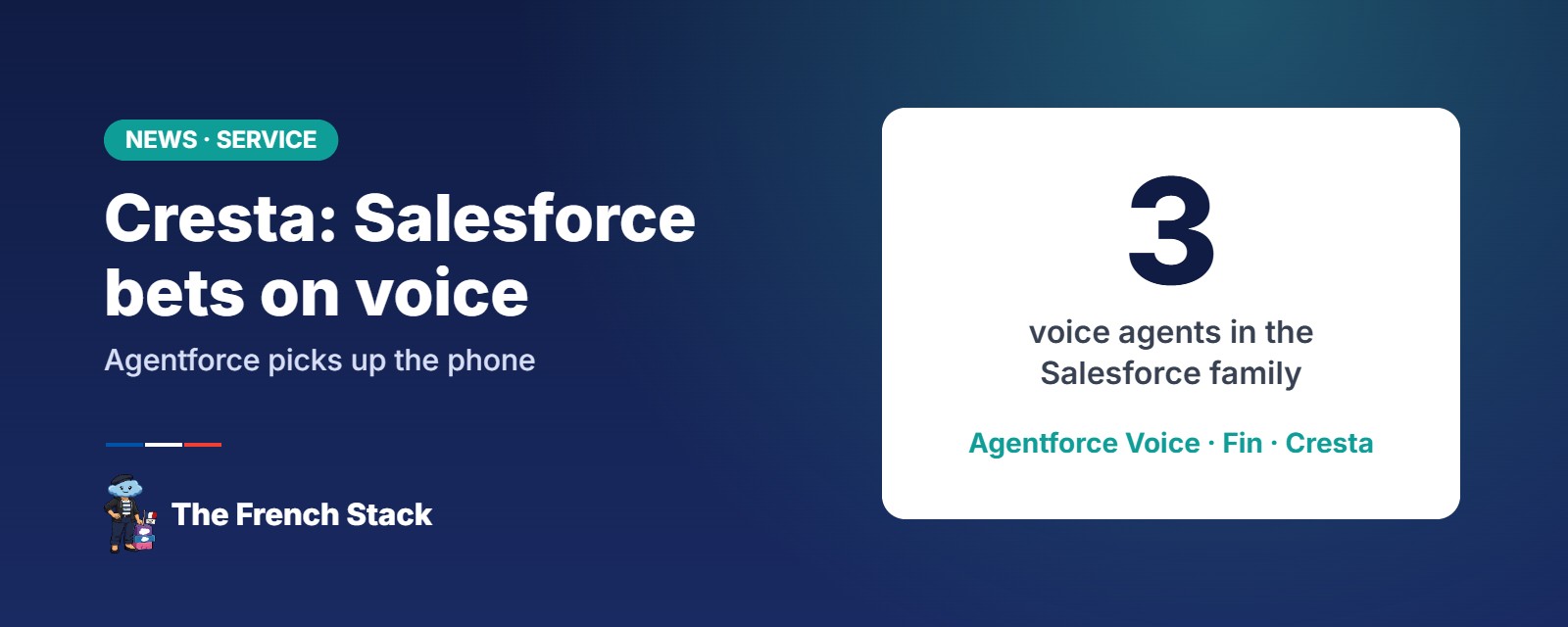
On 2 November 2026, Salesforce signed a definitive agreement to acquire Cresta, a company specialised in voice AI for contact centres. Two weeks after announcing the Braze acquisition, it is another autumn move, and it says a lot about Salesforce’s ambitions: getting Agentforce to pick up the phone.
What is Cresta?
Cresta describes itself as the “voice-first operating system for customer experience”. In practice, the platform brings together three building blocks:
- AI voice agents able to handle customer calls end to end, including complex ones.
- Real-time assistance for human agents, guiding them during the call.
- Conversation intelligence to analyse interactions and improve service quality.
Salesforce plans to connect Cresta to Service Cloud, linking every conversation to the customer record and service processes (Salesforce).
The deal in figures
- Price: not disclosed by Salesforce. The Information reported about $2.7 billion, a figure no official source has confirmed (CMSWire).
- Timing: closing is expected in the first quarter of Salesforce’s fiscal year 2028, i.e. early 2027, subject to customary approvals.
- Openness: after the deal, Cresta will keep supporting the main contact centre and telephony platforms its customers use.
A voice strategy built step by step
Cresta does not come out of nowhere. Over the past year, Salesforce has been stacking up the building blocks to become a serious contact centre player:
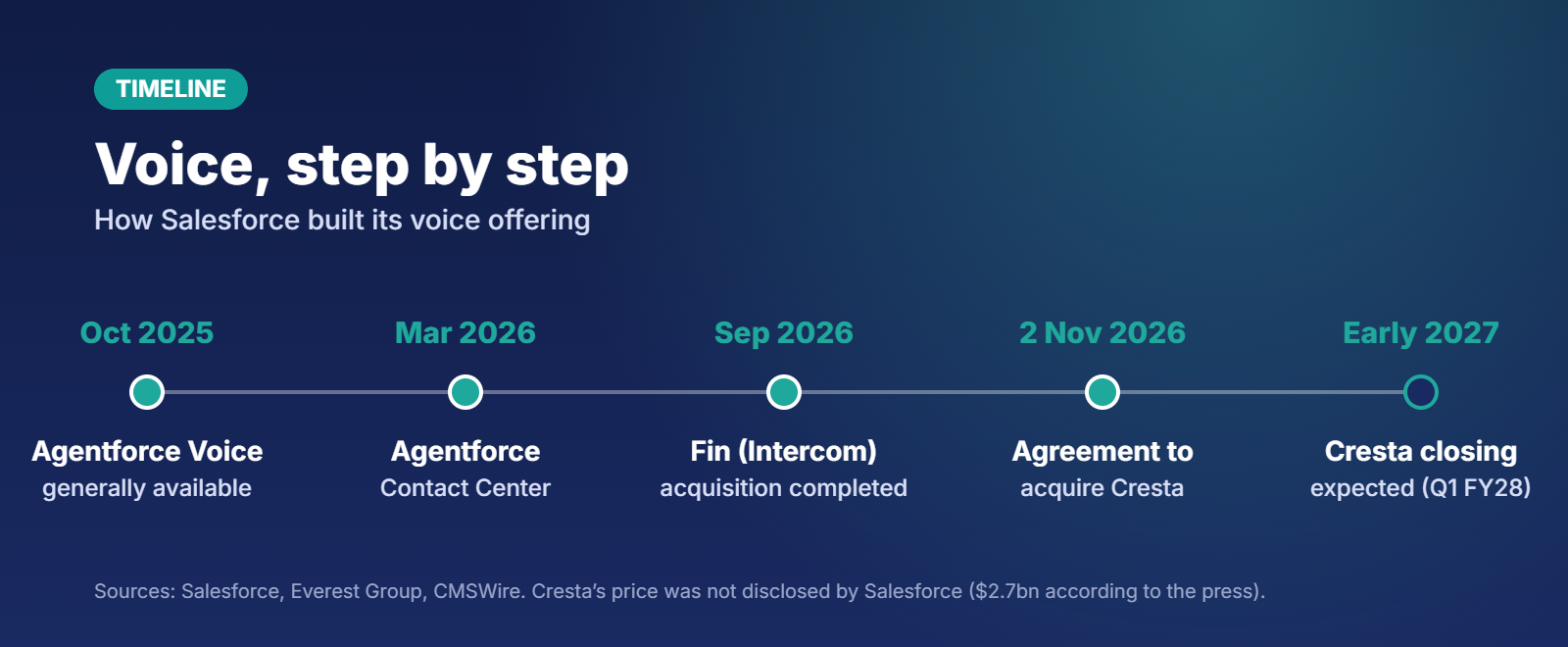
As a result, Salesforce now has three voice agents in its family, Agentforce Voice, Fin and soon Cresta, without having clarified yet how they will split the roles (Everest Group).
What analysts say
For Everest Group, the deal illustrates a shift: value is moving from the number of agent seats to the number of interactions actually resolved. Cresta also lets Salesforce be present in conversations even when the customer keeps its contact centre provider (Genesys, NICE, Five9, Amazon Connect…).
The watch points raised: the overlap between the three voice agents, pricing models that may stack up (licences, credits, per-resolution billing, telephony), and the need to rethink quality assurance when humans and AI handle the same calls.
What it means for you
- Service Cloud consultants: voice is becoming central. Service Cloud Voice, Agentforce Contact Center and voice agent design are skills to build now.
- Architects: expect trade-offs between Agentforce Voice, Fin and Cresta, and integrations with existing telephony.
- Customers: nothing changes before closing. It is a good time to map your call journeys and identify what could be automated.
Our take
The phone remains the channel for the most urgent and complex requests. By acquiring Cresta, Salesforce goes after the heart of the contact centre, where much of customer satisfaction is decided. The bet is ambitious, but clarity will be decisive: three voice agents are two too many if nobody knows which one to pick.
Further reading: Constellation Research, Techstrong.ai.